
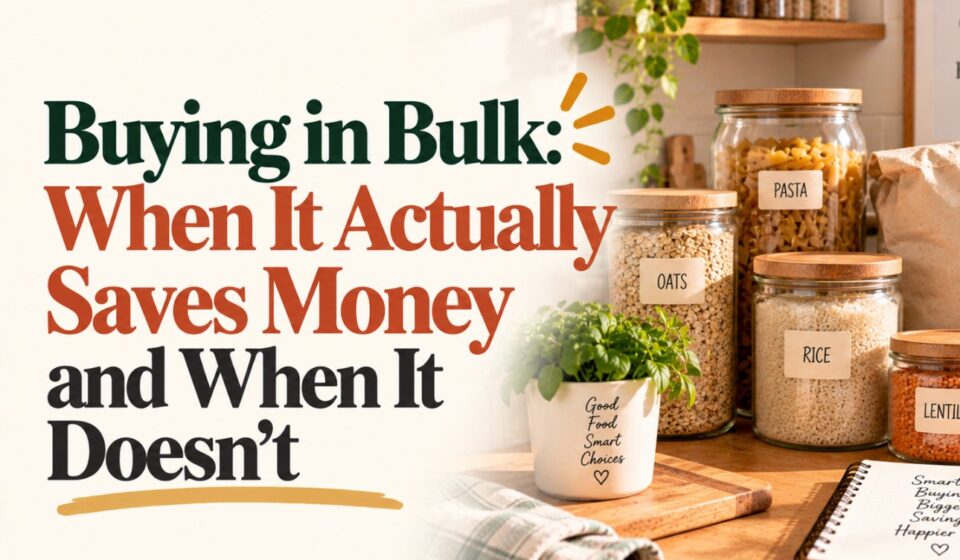

Warehouse stores and bulk buying have a powerful appeal. The unit prices look dramatically lower, the packaging is satisfying in its abundance, and there’s a certain logic to “more for less” that feels undeniably frugal.
But bulk buying is one of the most misunderstood money-saving strategies out there — because it only saves money under specific conditions, and under the wrong conditions it costs significantly more than buying normally.
The people who genuinely save money at Costco and Sam’s Club aren’t just buying everything in bulk. They’re buying the right things in bulk — the ones where the math actually works. And they’re skipping bulk on everything else.
This guide breaks down exactly when bulk buying saves money, when it doesn’t, and how to tell the difference before you load up a flatbed cart with 96 rolls of paper towels.
If you’re working on reducing your grocery spending overall, this complements our how to cut your grocery bill in half guide and the unit price strategies we covered in our how to save money on groceries every week guide.
The Core Rule of Bulk Buying
Bulk buying saves money when and only when all three of these conditions are true:
- The unit price is genuinely lower than what you’d pay buying normally
- You will actually use the product before it expires or goes bad
- You have the storage space to accommodate the larger quantity
Miss any one of these three and bulk buying costs you money rather than saving it. It’s that simple — and that frequently misunderstood.
When Bulk Buying Genuinely Saves Money
Non-Perishable Pantry Staples
This is where bulk buying is almost always a legitimate win. Products that don’t expire quickly, that you use consistently, and that have a straightforward unit price comparison.
The best bulk buys in this category:
Rice and dried grains — you will use it, it stores indefinitely, and the unit price in bulk is almost always lower. A 25lb bag of rice from a warehouse store typically costs 30-50% less per pound than a 2lb bag from a regular supermarket.
Dried pasta — same logic as rice. Lasts over a year stored properly, used regularly by most households, consistently cheaper per pound in bulk.
Canned goods — buying canned tomatoes, beans, and tuna by the case is usually cheaper per can than buying individually, and canned goods last 2-5 years. The only risk is having more than you have shelf space for.
Dried beans and lentils — essentially indefinite shelf life, used in countless meals, and dramatically cheaper per pound in bulk than in small packages.
Olive oil and cooking oils — if you cook regularly, you go through oil fast enough that bulk makes sense. The unit price in large containers is meaningfully lower and oil has a long shelf life unopened.
Spices — if you cook a lot, buying spices in bulk from a bulk foods section (rather than jarred) is significantly cheaper. Especially cumin, paprika, garlic powder, and other high-use spices.
THRIFTY HABIT #44 Before buying anything in bulk, do the unit price math every single time — never assume bulk is cheaper. Divide the total price by the number of units (ounces, pounds, items). Compare to what you normally pay. If bulk is cheaper AND you’ll use it before it expires, buy it. If not, don’t.
Paper Products and Cleaning Supplies
Paper towels, toilet paper, dish soap, laundry detergent — these don’t expire, you will absolutely use them, and the unit price in bulk is almost always significantly lower.
A Costco-sized pack of toilet paper or a large jug of laundry detergent typically saves 30-50% compared to buying the same amount in smaller packages over time. This is one of the clearest bulk buying wins for most households.
The only limiting factor is storage — make sure you have somewhere to put 40 rolls of paper towels before committing.
Frozen Meat When It’s on Sale
Buying meat in bulk when it’s on sale — and immediately freezing what you won’t use this week — is one of the highest-return bulk buying strategies available.
A 10lb package of chicken thighs on sale at $1.49/lb beats a 2lb package at $2.99/lb by a significant margin. The savings are real and the product keeps in the freezer for 3-6 months.
This requires freezer space and a bit of upfront cost, but the per-meal savings over the following months are substantial. We covered this in detail in our budget-friendly meals guide — buying proteins strategically is one of the best ways to reduce cost per meal.
Items You Use at Predictable High Volume
Every household has products they go through rapidly and consistently. For a family with young children it might be juice boxes and snack crackers. For a household that cooks heavily it might be olive oil and canned tomatoes. For someone who makes coffee at home every day it might be coffee beans.
Whatever your high-volume staples are, those are your best bulk candidates — because you know with certainty you’ll use them before they expire, and the unit price saving is real money.
When Bulk Buying Does NOT Save Money
Perishable Produce and Fresh Foods
This is the number one bulk buying mistake — buying more fresh food than you can realistically use before it goes bad.
A 5lb bag of spinach is a terrible deal if you throw away 3lbs of it. A flat of strawberries sounds like great value until half of them mold before you eat them. The unit price saving is irrelevant if a significant portion of what you bought ends up in the trash.
As we covered in our how to stop wasting food guide, food waste is one of the biggest drains on grocery budgets. Buying fresh produce in bulk that you can’t realistically consume accelerates that waste rather than reducing it.
The exception: if you’re buying fresh produce specifically to freeze or preserve immediately — bulk strawberries for jam, bulk tomatoes for sauce, bulk peppers to freeze — the math can work. But that requires actually doing the preserving, not intending to do it.
WORTH IT / SKIP IT Buying bulk fresh produce with vague plans to use it: SKIP IT every time. Be honest with yourself about how much of something you realistically eat in a week. If it’s one bell pepper, a 5lb bag is a food waste machine, not a money saver.
Anything With a Short Shelf Life That You Don’t Use Quickly
Beyond fresh produce, this applies to:
- Bread (goes stale or moldy — unless you freeze it immediately)
- Dairy products (milk, yogurt, soft cheese — the clock starts the moment you open them)
- Nuts and seeds in large quantities (go rancid faster than most people expect, especially once opened)
- Whole grain flours (oils in whole grains go rancid; white flour stores much longer)
- Cooking oils in quantities too large to use within a few months of opening
The key test: how long will this realistically take your household to use once opened? If the answer is longer than the product’s open shelf life, don’t buy in bulk.
Products You Haven’t Tried Before
Never buy in bulk something you haven’t confirmed you like.
This sounds obvious but it’s a very common bulk buying mistake — buying 48 servings of a protein bar you’ve never tried, or a gallon of a sauce you’ve only used once. If you don’t love it, you’re stuck with 47 more protein bars and a gallon of sauce you’ll use once a month until it eventually goes bad.
Try it first in a normal quantity. If you love it and use it regularly, then consider bulk.
Items That Are Only Cheaper Because of the Larger Package — Not Per Unit
Not everything sold in a larger package is actually cheaper per unit. This is worth stating clearly because the assumption that “bigger = cheaper” is so pervasive.
Always check the unit price on the shelf label. Sometimes the “bulk” size is priced at exactly the same unit price as the regular size. Sometimes — particularly with sale items — the regular supermarket has the same or better unit price than the warehouse store.
THRIFTY HABIT #45 Never walk into a warehouse store assuming everything is cheaper than your regular grocery store. Some things are dramatically cheaper. Some things are comparable. A few things are actually more expensive. The only way to know is to compare unit prices — which means knowing what you normally pay for your regular staples.
Trendy or Seasonal Items
The bulk buying model encourages you to buy large quantities of things. That’s fine for staples you always use. It’s a problem for anything seasonal or trend-driven — a spice blend you bought for one recipe, a seasonal flavor you thought you’d love, a snack that was popular for a month.
Bulk buying only makes sense for items with permanent, predictable consumption in your household.
The Warehouse Store Membership Question
Costco, Sam’s Club, and BJ’s all charge annual membership fees ($65-130 per year depending on the tier). Whether that fee pays for itself depends entirely on how you shop.
A membership makes financial sense when:
- You buy enough qualifying bulk items that the unit price savings exceed the annual fee
- You use the store’s gas station (warehouse store gas is often 10-20 cents cheaper per gallon)
- You use additional member benefits like the pharmacy, optical, or travel services
A membership does not make financial sense when:
- You only go occasionally and don’t have the storage for large quantities
- You buy mostly perishables or items that aren’t significantly cheaper in bulk
- You tend to overbuy because the large quantities feel like good value
The honest calculation: add up what you’d realistically spend at the warehouse store over a year on the items where it’s genuinely cheaper, calculate the unit price saving, and compare it to the membership fee. If the saving exceeds the fee, the membership pays for itself. If not, a regular supermarket with smart shopping habits beats the warehouse store.
A Practical Bulk Buying Framework
Before buying anything in bulk, run through these four questions:
1. Is the unit price actually lower? Do the math. Don’t assume.
2. Will I use all of this before it expires or goes bad? Be honest, not optimistic. If you use one can of coconut milk a month, don’t buy 24.
3. Do I have somewhere to store it? Bulk buying doesn’t work without storage space. A pantry full of things you can’t reach because of badly stored bulk purchases defeats the purpose.
4. Have I tried this product and confirmed I like it? Never bulk buy something new.
Four yes answers: buy in bulk. Any no answers: buy the regular size.
The Best and Worst Bulk Buys at a Glance
| Always Buy in Bulk | Never Buy in Bulk |
|---|---|
| Rice, pasta, dried grains | Fresh produce (unless freezing immediately) |
| Canned goods | Bread (unless freezing immediately) |
| Dried beans and lentils | New products you haven’t tried |
| Cooking oils | Trendy or seasonal items |
| Paper products and toilet paper | Products with comparable regular unit prices |
| Laundry and dish soap | Nuts and seeds (unless you use them very fast) |
| Frozen meat (with freezer space) | Dairy with short open shelf life |
| Spices you use constantly | Whole grain flours |
| Coffee (if you drink it daily) |
The Bottom Line
Bulk buying is a genuine money-saving strategy — for the right products, bought with the right habits. It is not an automatic win just because the package is bigger or the warehouse store feels like a good deal.
The households that save the most with bulk buying are the ones who treat it as a deliberate, calculated decision rather than a default shopping mode. They know their unit prices. They know their consumption rates. They buy staples in bulk and fresh food in sensible quantities.
Apply the same thinking to your shopping and bulk buying becomes a reliable money-saving tool rather than a source of wasted food and buyer’s remorse.
What’s your best bulk buying win — and the biggest bulk buying mistake you’ve made? Drop it in the comments, I’d love to hear both!