
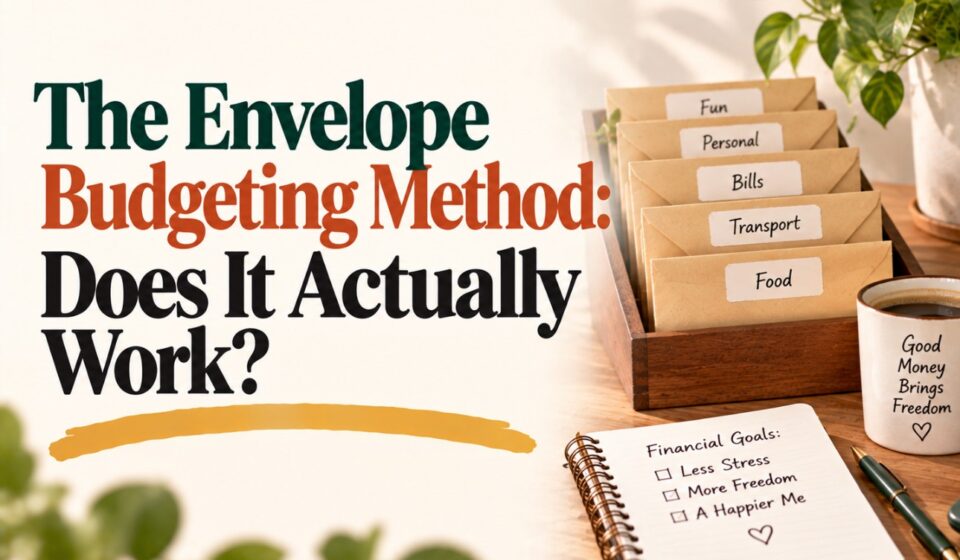

The envelope budgeting method is one of the oldest personal finance systems around — and one of the most debated.
The concept is simple enough to explain in one sentence: you divide your cash into physical envelopes labeled by spending category, and when an envelope is empty, you stop spending in that category for the month.
No apps. No spreadsheets. No syncing to your bank account. Just cash, envelopes, and a hard stop.
In an era of tap-to-pay, digital wallets, and contactless everything, the envelope method sounds almost charmingly outdated. And yet it has a genuinely devoted following — people who tried every budgeting app and spreadsheet system and only found traction when they went back to physical cash in paper envelopes.
So does it actually work? The honest answer is: for specific people with specific spending problems, yes — remarkably well. For others, it’s an unnecessary complication of a problem better solved differently. This guide helps you figure out which category you’re in.
How the Envelope Method Works
The Basic System
- At the start of each month, you withdraw cash for your discretionary spending categories
- You divide the cash into labeled envelopes — Groceries, Dining Out, Entertainment, Clothing, Personal Care, and so on
- You spend only from the relevant envelope for each category throughout the month
- When an envelope is empty, spending in that category stops — no exceptions, no transfers from other envelopes
- Fixed bills (rent, utilities, car payment) are paid normally — the envelope system typically covers discretionary spending only
That’s the whole system. The power is entirely in the physicality of cash — the tangible, finite nature of money you can see and feel — and the hard stop that an empty envelope provides.
What Categories to Use
The categories are personal and should reflect how you actually spend. Common ones:
- Groceries
- Dining out and takeout
- Entertainment
- Clothing
- Personal care and grooming
- Gas
- Household supplies
- Fun money / personal spending
- Gifts
- Kids’ activities
Fixed expenses — rent, insurance, utilities, subscriptions — typically aren’t in envelopes because they’re predictable and not subject to the same impulse-spending patterns that the envelope system addresses.
How Much Goes in Each Envelope
Base the amounts on your actual budget — which means doing the beginner’s guide to budgeting work first. The envelope system is an execution tool, not a planning tool. You still need to know your income, your fixed expenses, and how much is available for discretionary spending before you can allocate it to envelopes.
If your total discretionary budget is $800/month, you divide that $800 across your categories based on your priorities and history. The monthly spending audit is useful here — knowing what you’ve been spending in each category helps you set realistic envelope amounts rather than aspirational ones that empty immediately.
Why It Works (The Psychology)
The envelope method’s effectiveness — when it works — comes from three psychological mechanisms that digital budgeting tools can’t fully replicate.
Cash Feels Different Than Cards
This is the most important mechanism and the most well-documented.
Research consistently shows that people spend more with credit and debit cards than with cash — often significantly more. The leading explanation is the “pain of paying” — physical cash produces a more visceral sense of loss when spent than a card tap, which feels nearly frictionless.
When you hand over a $20 bill for something, you feel it leave. When you tap a card, you don’t. That feeling matters behaviorally — it produces more deliberate spending decisions and more awareness of accumulation.
For people whose overspending is driven by the frictionless ease of digital payment — who don’t feel themselves spending until they look at the bank statement — cash envelopes reintroduce the friction that keeps spending conscious.
The Hard Stop Is Real
With digital budgeting, an empty category is a number on a screen. It can be ignored. It can be mentally overridden with “I’ll make it up next month.” It generates no actual consequence in the moment.
An empty envelope is a physical reality. The money is not there. You can see it’s not there. You cannot pretend it’s not there.
This hard stop changes behavior in a way that category alerts and budget tracking notifications simply don’t — because it operates at the moment of the purchase decision rather than after the fact.
It Creates Awareness Without Tracking
Most budgeting systems require tracking — logging transactions, categorizing purchases, reconciling accounts. This is valuable but requires ongoing effort that many people find tedious and eventually abandon.
The envelope system creates category awareness automatically through the physical act of paying. You don’t need to log that you spent $47 at the grocery store — you see the grocery envelope getting lighter and you know where you are without any tracking effort.
For people who abandon budgeting apps because the tracking feels like too much work, the envelope system provides similar awareness through a different mechanism.
THRIFTY HABIT #126 If you’re considering trying the envelope method, start with just two or three problem categories rather than your entire budget. The category where you consistently overspend — groceries, dining out, personal spending — is where the system has the most to offer. Test it there for one month before deciding whether to expand it.
The Honest Limitations
For all its psychological effectiveness, the envelope method has real practical limitations in 2027 that are worth naming honestly.
Most Spending Isn’t Cash-Friendly Anymore
Online shopping, subscription services, digital payments, automatic bills — a significant and growing portion of most people’s spending happens in contexts where cash literally cannot be used.
Amazon doesn’t take envelopes. Your Netflix subscription doesn’t accept cash. The gas pump requires a card. The envelope method requires either supplementing with a parallel digital system for these categories or accepting that a meaningful portion of your spending exists outside the system entirely.
Cash Management is Genuinely Inconvenient
Withdrawing the right amount of cash on the right day each month. Making sure you have the right envelope with you when you’re at the right store. Getting change back and figuring out where it goes. Running out of cash in one category and having to decide what to do.
These friction points are minor individually. Collectively, for people who manage busy lives, they represent real inconvenience that erodes consistency.
Carrying Cash Has Risks
Lost cash is gone. Stolen cash is gone. There’s no fraud protection, no transaction record, no ability to dispute a charge. For people who travel, frequently shop online, or live in areas where carrying cash feels risky, these aren’t trivial concerns.
It Doesn’t Build Financial Understanding
The envelope method tells you when you’ve run out of money in a category. It doesn’t tell you why your spending patterns are what they are, what your triggers are, or how your spending compares to your income over time. As a standalone system it addresses symptoms (overspending in categories) without necessarily building the financial awareness that makes other good habits possible.
Who the Envelope Method Works Best For
Based on how the system actually functions, it’s most effective for:
People who spend unconsciously with cards. If you consistently overspend without realizing it until the bank statement arrives — if the frictionless nature of digital payment is the specific problem — cash envelopes address this directly.
People who have failed at app-based budgeting. If you’ve tried YNAB, Mint, and spreadsheets and they all failed because the tracking felt like too much maintenance, the envelope method’s tracking-free awareness mechanism may suit you better.
People with specific impulse spending categories. If dining out or personal shopping or entertainment is the specific category that always blows your budget, a cash envelope for just that category — while keeping everything else digital — is a targeted intervention.
Cash-heavy spenders. People who already use cash regularly, shop primarily at physical stores, and live in contexts where cash is practical face fewer of the practical limitations above.
Visual learners and tactile people. The physical reality of the envelope system — seeing the cash, holding it, feeling it diminish — works better for people who process information visually and tangibly than for abstract thinkers comfortable with numbers on screens.
Who It Probably Doesn’t Suit
Frequent online shoppers. If most of your discretionary spending happens online or through subscriptions, the cash system addresses a small portion of your actual spending.
People already succeeding with digital tracking. If you’re consistently hitting your budget categories with a digital tool, there’s no problem to solve. Don’t fix what isn’t broken.
People who travel frequently or have variable schedules. The logistics of cash management become significantly more complicated when your routine varies week to week.
Detail-oriented people who want financial data. The envelope system produces no transaction history, no spending pattern analysis, no data. People who want to understand their spending patterns over time are better served by tracking systems that generate that information.
A Modern Hybrid Approach
Many people find that a hybrid of the envelope method and digital tools works better than either alone.
Cash envelopes for problem categories — the two or three categories where overspending is a consistent issue. The physical cash creates the friction and the hard stop where they’re most needed.
Digital tracking for everything else — subscriptions, online purchases, fixed expenses, and categories that aren’t problem areas remain in the digital system where they’re most convenient to manage.
This hybrid captures the psychological benefit of the envelope method where it matters most while avoiding the practical limitations of a fully cash-based system.
WORTH IT / SKIP IT Trying the full envelope method as a month-long experiment: WORTH IT if you consistently overspend and haven’t found a digital system that sticks. The month will tell you quickly whether the cash mechanics actually change your behavior or whether the problem is elsewhere. SKIP IT if most of your spending is online or digital and you already have decent awareness of where your money goes.
How to Set It Up This Month
If you want to try it, here’s the practical setup:
Step 1: Do your budget first. Know your income, your fixed expenses, and how much is available for discretionary spending. The beginner’s guide to budgeting covers this.
Step 2: Choose your categories. Start with the two or three where you consistently overspend.
Step 3: Decide the amounts. Base them on realistic spending, not aspirational — if you’ve been spending $400 on groceries and set the envelope at $200, it will empty in two weeks and the system will feel like it’s failing when it’s actually working correctly.
Step 4: Withdraw the cash on payday. Go to your bank or ATM, get the specific amounts in cash, label your envelopes, distribute.
Step 5: Use only the relevant envelope for each category. Grocery store: grocery envelope. Restaurant: dining out envelope. End of month: count what’s left and adjust amounts for next month if needed.
Step 6: Run it for a full month before evaluating. The first month is adaptation. The second month is where you know whether it’s working.
The Bottom Line
The envelope method works — but not for everyone and not for every spending problem.
Its strength is psychological: cash is real in a way cards aren’t, empty envelopes are stopping mechanisms in a way budget alerts aren’t, and awareness created through physical payment is more visceral than awareness created through transaction logs.
Its weakness is practical: modern spending is increasingly digital, cash management adds friction to daily life, and the system generates no useful financial data.
For the right person with the right spending problem — unconscious card spending in specific categories — it’s one of the most effective behavioral tools in personal finance. For everyone else, the best free budgeting apps guide covers digital alternatives that work better for different situations.
The best budgeting system is the one you’ll actually use consistently. If you’ve been unable to use anything consistently, the envelope method is worth trying — if only to find out whether the problem was the system or something else entirely.
Have you tried the envelope method — and did it work for you? Drop it in the comments, I’d love to hear both the success stories and the “this didn’t work for me because” ones.