
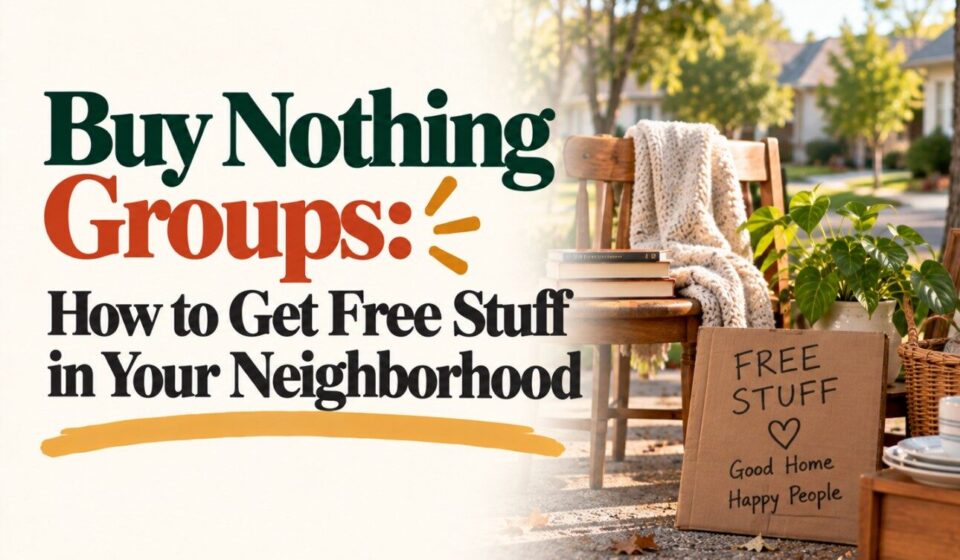

There’s a parallel economy running quietly in neighborhoods across the country — one where people give away perfectly good furniture, clothing, kitchen equipment, kids’ gear, tools, plants, and hundreds of other items completely free to their neighbors.
No catch. No exchange. No payment of any kind.
It’s called the Buy Nothing Project, and if you’re not already using it, you’re leaving real money on the table every time you buy something you could have gotten for free — or throw away something a neighbor would genuinely want.
This guide covers exactly what Buy Nothing groups are, how to find yours, how to get the most out of them as both a receiver and a giver, and how they fit into a broader frugal living strategy that reduces what you spend while building genuine community connections.
For anyone working through our declutter your home and make money guide or looking to reduce spending on household items, Buy Nothing groups are one of the most underused tools available — completely free, locally based, and surprisingly well-stocked.
What Is the Buy Nothing Project?
The Buy Nothing Project was founded in 2013 by Liesl Clark and Rebecca Rockefeller on Bainbridge Island, Washington. The core idea is simple: create hyperlocal gift economies where neighbors give and receive items freely, building community connections in the process.
The rules are deliberately simple:
- Everything is free — no bartering, no payment, no exchanges
- Groups are hyperlocal — typically one neighborhood or zip code
- Anyone in the geographic area can participate
- Gifts go to whoever the giver chooses — not necessarily first come, first served
What started as a Facebook group experiment has grown into a global network of tens of thousands of groups with millions of members. There’s almost certainly one in your neighborhood right now.
Where to Find Your Local Buy Nothing Group
Facebook Groups
The majority of Buy Nothing groups operate as private Facebook groups. Search “Buy Nothing [your neighborhood or city name]” on Facebook and request to join. Most groups approve requests within a day or two after confirming you live in the area.
If there isn’t a group for your specific neighborhood, search the surrounding area — groups for adjacent neighborhoods often accept members from nearby areas, or you can start one yourself (the Buy Nothing Project website has guides for this).
The Buy Nothing App
The Buy Nothing Project launched its own dedicated app that operates independently of Facebook — useful if you’re not on Facebook or prefer a purpose-built interface. The app is available on iOS and Android and connects to the same hyperlocal network.
Nextdoor
Many neighborhoods have informal “free stuff” posts on Nextdoor that function similarly to Buy Nothing — not an official Buy Nothing group but the same concept. Worth checking alongside the dedicated groups.
What People Actually Give Away
This is where Buy Nothing surprises most newcomers. The quality and variety of items given away is genuinely remarkable.
Furniture and home goods: Sofas, chairs, tables, dressers, bookshelves, lamps, rugs, artwork, mirrors, curtains, decorative items. Full living room sets. Kitchen tables with chairs. Beds and bed frames. People moving, downsizing, or redecorating give away furniture that would sell for hundreds of dollars on Facebook Marketplace.
Kitchen and household: Appliances (stand mixers, blenders, coffee makers, slow cookers), cookware, dishes, glasses, storage containers, small appliances still in the box. People who received duplicate gifts, upgraded their kitchen, or are clearing out decades of accumulated items give away things that are genuinely useful and in excellent condition.
Children’s items: This is one of the most active categories in most Buy Nothing groups. Baby gear (bouncers, swings, high chairs, monitors), clothing in every size, toys, books, games, school supplies, sports equipment. Children grow fast and parents accumulate gear rapidly — Buy Nothing groups are how a lot of it finds a second home.
Clothing: All sizes, all styles, all seasons. Some groups are particularly active for clothing — members post entire wardrobes when they declutter, and other members can request specific items or sizes.
Books, media, and games: Books of all types, DVDs, board games, puzzles, video games. People clearing bookshelves or downsizing physical media collections give away items that are still enjoyable and in great condition.
Garden and outdoor: Plants (cuttings, divisions, seedlings, established plants), garden tools, pots, seeds, outdoor furniture, sports equipment, bikes. Gardeners in particular are generous — plant propagation naturally produces more than any one person needs.
Food: Excess garden produce, pantry staples before a move, baked goods, herbs. Less common than physical items but not unusual.
Skills and services: Some groups allow members to offer skills — a haircut, help moving furniture, tutoring, pet sitting. Not all groups include this, but some have expanded beyond physical items.
THRIFTY HABIT #79 When you join your local Buy Nothing group, spend the first week just observing — reading posts, seeing what gets offered and how quickly, understanding the community culture before posting yourself. Each group has its own norms and pace. A week of observation makes your first participation much smoother.
How to Request Items Effectively
Posting a request in a Buy Nothing group is not like bidding on eBay. The giver chooses who receives their item — and they often choose based on factors beyond who commented first.
Write a genuine post. Explain what you need and why. Not a manipulative sob story — just a real, human reason. “I just moved into my first apartment and need a coffee table” is more compelling than “I want a coffee table.” Givers like knowing their item is going somewhere it’s genuinely needed.
Be specific about what you need. Size, color preferences, condition you’d accept — specific requests are easier to fulfill than vague ones and help givers know whether their item is a match.
Respond promptly. When a giver selects you, respond quickly to arrange pickup. Slow responses frustrate givers and you may lose the item to someone else.
Be flexible on timing. Coordinate pickup around the giver’s schedule, not just your own. They’re doing you a favor.
Follow through. If you commit to picking something up, actually pick it up. Ghosting after being selected is one of the most frustrating experiences for givers and damages trust in the community.
Say thank you. A brief thank you post after receiving something — maybe with a photo of the item in its new home — builds goodwill and makes givers feel good about their decision. It also makes you a known, trustworthy member of the group.
How Givers Choose Recipients
Understanding how givers make decisions helps you frame your requests more effectively.
Story and connection. Many givers choose the person whose post resonated with them most — someone who explained a genuine need or made a human connection. A well-written request stands out.
Group history. Active members who give generously are often prioritized by other givers. Participation goes both ways — members who only take and never give tend to be deprioritized over time in communities that track this informally.
Logistics. Sometimes the person who can pick up soonest or most conveniently gets chosen, especially for large items the giver wants gone quickly.
Creative responses. Some givers run mini-contests — “tell me your favorite book” or “what would you do with this?” — as a fun way to choose. These are signals that the giver wants a connection, not just the fastest response.
How to Give Effectively
Buy Nothing is a two-way community. The groups work best — and you get the most out of them — when you participate as both a giver and receiver.
Post things before Goodwill. Before loading anything into donation bags, check whether it would be wanted in your Buy Nothing group. Items that would get lost in a thrift store donation pile often go to a neighbor who genuinely wants them — and you know exactly where your items went.
Post honestly. Describe the condition accurately. “Works perfectly, just upgrading” is different from “worked last time I used it two years ago.” Honest descriptions build trust and prevent disappointed recipients.
Choose your recipient thoughtfully. Take a few hours before selecting — you’ll often get multiple responses, and the one that came 30 seconds first isn’t necessarily the best home for the item.
Make pickup easy. Leave items on your porch if possible. Coordinating schedules for every pickup is time-consuming — a “porch pickup” arrangement works well for most items and is widely used in Buy Nothing communities.
Give things you’d actually want to receive. The spirit of the group is generosity, not dumping. Broken, stained, or truly unusable items belong in the trash, not a gift post.
THRIFTY HABIT #80 Keep a “Buy Nothing box” near your front door — a small box where you put things as you come across them that could go to the group. When it’s full or you have a few minutes, post the items. This makes giving a continuous habit rather than a big declutter event, and it keeps your home steadily less cluttered.
Buy Nothing vs Other Free Options
Buy Nothing isn’t the only way to get free stuff — it’s worth knowing how it compares to alternatives:
| Platform | Best For | Key Difference |
|---|---|---|
| Buy Nothing Groups | Neighborhood community, any item type | Hyperlocal, relationship-based, truly free |
| Facebook Marketplace (free section) | Quick free items, no community element | Anonymous, first-come-often-wins |
| Craigslist Free | Large items, quick disposal | Anonymous, inconsistent quality |
| Nextdoor | Neighborhood items and services | Slightly broader community than Buy Nothing |
| Freecycle | Free items, email-based | Older platform, less active in many areas |
Buy Nothing’s differentiator is the community element. It’s not just a platform for transferring items — it’s a neighborhood relationship builder where the same people interact repeatedly over time. That relationship layer is what makes the quality of giving higher and the experience more personal than anonymous free listings.
The Financial Impact
It’s genuinely difficult to put a precise number on what Buy Nothing saves because it depends entirely on how actively you participate and what your neighborhood group has available.
But consider what active participants regularly receive for free:
- Furniture that would cost $200-800 to buy secondhand
- Children’s clothing and gear that would cost $50-300 per season
- Kitchen appliances worth $50-200
- Plants worth $20-100 at a garden center
- Books, games, and media worth $5-50 each
A household that actively participates in Buy Nothing for a year — requesting items they’d otherwise buy and giving away things they’d otherwise pay to dispose of — can easily avoid $500-2,000 in purchases and disposal costs.
This isn’t a precise number because it depends on what your group has and what you need. But the opportunity is real and consistently underused by people who don’t know it exists.
Buy Nothing and the Frugal Living Philosophy
Buy Nothing groups fit naturally into the frugal living mindset we’ve built throughout this site — but they add a dimension that pure cost-cutting doesn’t capture.
The frugal living philosophy isn’t just about spending less. It’s about aligning how you use resources — including money — with what actually matters. Buying less and getting more of what you need through community exchange does both simultaneously.
It reduces consumption. It reduces waste. It builds neighborhood relationships. It gives items a second useful life instead of a landfill. And it does all of that while saving real money.
Combined with the secondhand shopping habits from our how to shop secondhand guide and the decluttering approach from our declutter your home guide, Buy Nothing groups complete a circular approach to household items: buy secondhand when you need to buy, give freely when you have something to give, and let the community fill the gaps in between.
Getting Started Today
- Search “Buy Nothing [your neighborhood]” on Facebook and request to join
- Download the Buy Nothing app as a backup if the Facebook group is hard to find
- Spend a week observing the group before posting
- Post your first give — something from your home you no longer need
- Make your first request — something specific you genuinely need
The first give and the first receive are the hardest simply because they’re unfamiliar. After that the rhythm of the group becomes natural and the community value compounds over time.
Are you already in a Buy Nothing group — and what’s the best thing you’ve gotten or given? Drop it in the comments!